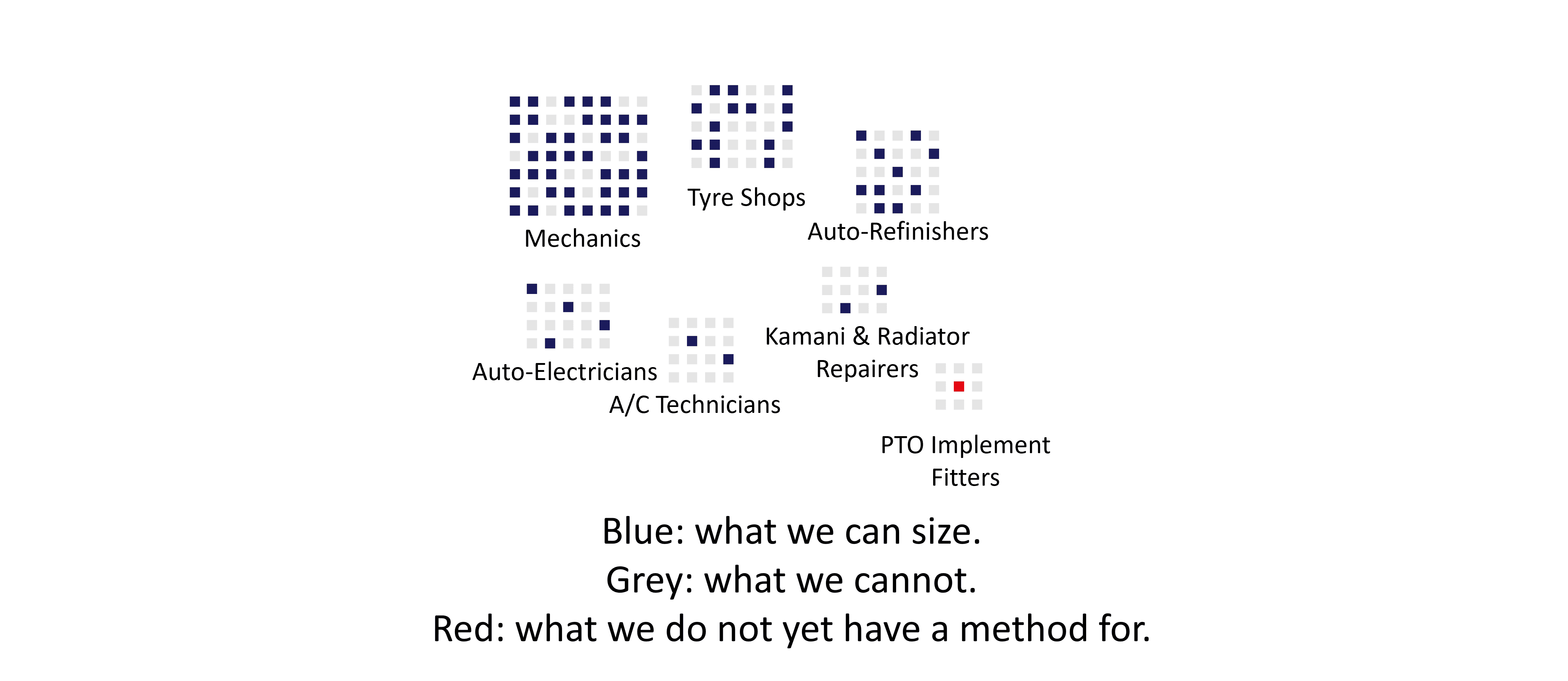
There is an old story about blind men describing an elephant, each from the part he can reach. The Indian automotive aftermarket works rather like that, and we are one of the blind men.
Nobody stands in the whole of this industry
A lubricant company knows mechanics. A tyre company knows tyre shops. A battery company knows auto electricians. A paint and putty company knows refinishers. Each of them knows its own part of the market properly, in detail, down to how a decision actually gets made in that shop. About the rest they know roughly what everybody else knows, which is not a great deal.
We are in the same position. Our work sits in some of these trades and not in others, and this piece is not a claim to see the whole animal.
What we are attempting is narrower. Establish what the parts actually are, then build a way of sizing each of them. The last piece promised a range rather than a single figure, and that still holds.
Every part of this industry has its own tradesman, and its own word for him
To a lubricant or spare parts company, the man is a mechanic. To a tyre company he is a tyre technician. To a battery or auto-electrical company he is an auto electrician. To a paint and putty company he is a refinisher.
Each of these companies will tell you it covers the trade. Each of them means a different set of people. So those numbers were never comparable to begin with, whatever gets done with them afterwards.
And inside a single category, the numbers do not settle either. Two lubricant companies will size the same trade differently, because each carries its own assumption about how often a vehicle consumes the product, and its own assumption about how much of that work goes to the franchised network rather than to the independent trade. Neither figure is published anywhere. Both are estimates. So the answers diverge, and there is no way of telling whose is closer.
A vehicle in India passes through more separate businesses than most people outside the trade realise. Mechanical repair. Auto electrical. Air conditioning. Body and paint. Tyres and punctures. Wheel alignment. Kamani work, which is leaf spring repair and replacement, a trade with its own shops, its own clusters along highways and its own supply chain, and no real equivalent in the passenger car world. Radiator repair. Upholstery.
And then the ones that appear in nobody's count. On the farm side, the fitter who repairs the implements running off the tractor's PTO shaft: rotavators, threshers, harvesters, balers. That work is done by somebody, it is done for money, and it is part of this industry, but it does not show up in anybody's estimate of the aftermarket.
The way these trades sit together is not the same everywhere. Tractor body and paint work barely exists as a trade of its own. Where it happens, upcountry, it happens in the same yards that repair truck bodies and bus bodies, because that is where the welding and the metalwork and the paint already are. Three vehicle types, one shop, one set of people.
Which means one method will not do
The last piece described a way of working the number out. Start from the vehicles, estimate the labour the country's fleet demands, and separately count establishments from the street. That works for mechanical repair, because service schedules are published and the work is observable.
It does not work everywhere, and it does not need to. Some of these trades can be counted from what they consume rather than from what they do. The country's replacement tyre volume is a measured figure rather than an estimated one, published by the industry for those willing to pay for it, and a tyre shop's daily throughput is the sort of thing you can find out by asking. Two numbers, and you have the population. Refinish paint works the same way. So, roughly, do batteries and leaf springs.
Others can be counted from the equipment they cannot work without. Wheel alignment requires an alignment machine, and these machines are sold by a small number of suppliers who know how many are out there.
So this is going to be uneven, and we would rather say so now. Tyres will probably be easier to size than mechanics, because somebody already counts the tyres and nobody counts the mechanics. Some of these trades we will size well. Some we will bracket. For one or two we will say plainly that we do not yet have a method, and leave it open.
The authorised network is already counted, after a fashion
This piece is about the independent trade, and it is worth saying why.
The authorised side is documented, though not always usefully. Maruti Suzuki, for instance, publishes its network size and its rate of expansion, and reported reaching 5,926 after-sales touchpoints across 3,000 cities and towns at the end of the last financial year. A touchpoint is not a workshop, and other manufacturers count differently or do not publish a national figure at all.
We are leaving it where it is, because it is not the part anybody is confused about, and because it is broadly visible in a way the independent trade is not.
Who we are counting, and who we are not
We are counting the people a customer brings a vehicle to.
We are not counting the layer that serves the garages rather than the vehicles. The lathe and machining shops. The brake reliners. The crankshaft grinders. The rewinding shops. These are real businesses, and for some product categories they are the people who decide what goes into a vehicle. They are excluded because no customer walks into them with a vehicle, which means the method we set out in the last piece cannot reach them. Counting them would need a different model.
Inside mechanical repair, there are four kinds of business
They are not necessarily four sizes of the same thing. What separates them is where the parts come from, and how much of the choice has already been made before the vehicle arrives.
The first is the full workshop. Most of the equipment it needs, and stock of most fast-moving products on the shelf. It buys in bulk, it decides what it buys, and the customer sees the result.
The second has a shop, several staff and some equipment, but little or no stock. Parts are bought as the job comes in.
The third is the quick service format. One or more mechanics working just outside a major spare parts outlet, buying almost everything they fit from that one shop. Customers bring their vehicles here for periodic maintenance and running repairs. Little or no major repair work happens here.
The fourth is the roadside mechanic. A fixed place, a tool box, usually two or three others working the same stretch, and a handful of retail shops within walking distance that supply the lot of them.
Which brings up something that gets misread constantly. This trade is far more fixed than the word informal suggests. The roadside mechanic is at the same spot every day and has been for years. Garages mostly work out of rented space, so when rents in a locality rise they do move, but they move to the nearest space they can afford. They do not leave the locality and they do not leave the trade. Informal here does not mean transient. It means undocumented, which is a different problem, and the one we are trying to do something about.
One caution about the four. They describe mechanical repairs. They do not transfer to a paint booth, a kamani shop or an alignment bay, each of which has its own shape and its own economics. Which is exactly why this count has to be built trade by trade rather than as one national number sliced by size.
Then there is the question of who inside the shop actually decides
The obvious answer is the owner or the head mechanic, with the helpers and apprentices fitting what they are handed. That is roughly true, but not the whole story.
Labour rates in the independent trade are thin, and getting thinner. So the money in a workshop comes from several places, and often lands in different pockets.
The shop's profit is largely arbitrage. Parts and consumables bought in bulk, fitted into customers' vehicles, and charged at retail, near MRP. That is the owner's business, and the brand decision on parts follows the person taking that margin.
Labour charges are frequently the individual mechanic's own earning rather than the shop's. So is the money from scanning coupons on packs, where a scheme pays per scan. Which means that on some categories the person deciding what gets fitted is also the person collecting for it, and he is not the owner.
Physical rewards from loyalty programmes tend to end up as the owner's personal earnings rather than the business's.
So there is no single answer to who decides. It moves by product category, and it moves with where the money lands. A brand that has designed its reach around the wrong one of these people has been reaching the wrong person, and would have no way of knowing.
This is why we will report two numbers rather than one. How many people earn a living working on vehicles, which is a labour and skilling question. And how many independent points of brand decision exist, which is a coverage question. They are not the same number and they are not used for the same thing.
What we are going to count
Establishments as the headline figure, people as the supporting one.
Every service trade that receives a vehicle from a customer, reported separately where we can size it, and reported as a bracket where we cannot. Each one marked with how the number was arrived at, so that a reader can take the trades that matter to what they sell and judge for themselves how much weight to put on each.
The supplier layer to garages and the authorised network are going to be excluded, for reasons we have mentioned above.
And a range, with the working shown, rather than a single figure with the working hidden.
Three things only field visits can settle
There is no dataset anywhere that holds any of these. What share of establishments is one man working on his own. What share operates without premises at all, at a fixed spot. And the trade mix by settlement type: how many of each of these trades exists in a village, in a district town, in a city.
That last one is new. It was not needed when this looked like a single count. It is needed now that it is a count built trade by trade.
Where this stands today
The vehicle sales history and the tyre volumes are not sitting on a website waiting to be downloaded. The industry bodies compile them and sell them. We have bought them, and we are working through them now. That will take a few weeks.
So the next two pieces will be about method rather than numbers. How you get from decades of sales figures to a fleet that is actually on the road. And what a workshop does all day, which is not what the service schedule says it does, and which is the assumption most likely to send this whole exercise wrong.
That order is deliberate. If the reasoning has gaps, we would rather hear about them before the arithmetic is built on top.
The next piece starts on the vehicles. How many are actually out there, which turns out to be harder than it sounds, because vehicles do not stop existing one fine day.